Opening Up Their World
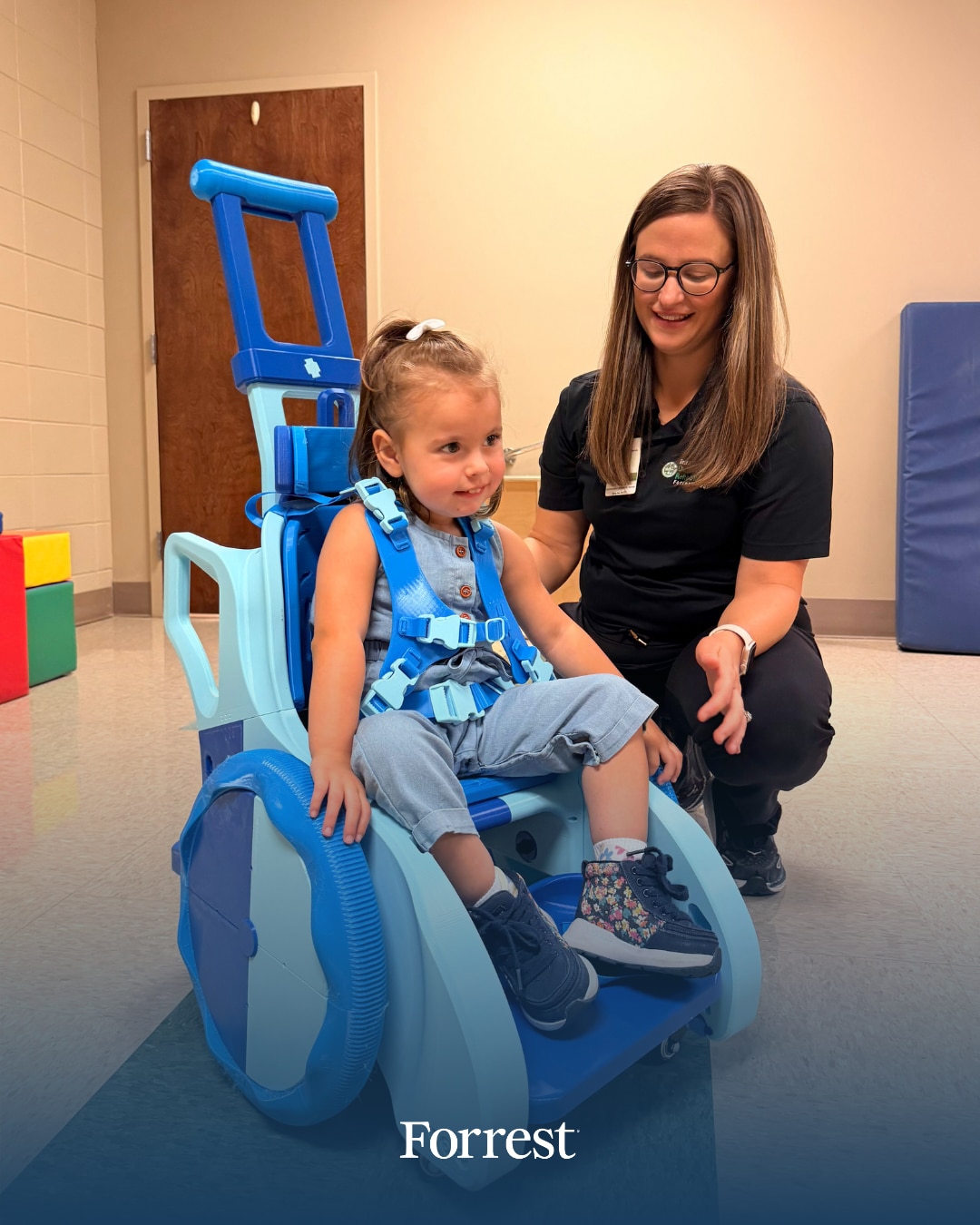
At two or three years old, children aren’t supposed to sit still.
They’re supposed to explore. To follow their friends or the family pet. To reach for things. To play. And, every now and then, to get into a little trouble.
For children who aren’t yet able to walk, something as simple as the ability to move across a room on their own can open up an entirely new world.
“Kids learn through play, through interaction, through their environment,” said Sara Huff, OTR, an occupational therapist and member of Forrest’s NICU developmental team. “When they have a wheelchair that fits them, they can get in and move themselves through their environment and go play and get into trouble. It just opens up their whole world.”
That was the world Huff wanted the girls in her Girl Scout Troop 4884 to think about when they began looking for a way to put their engineering skills to work for someone else.
Their solution was just their size — or, more accurately, the size of a toddler.
Using 3D-printed pieces, a set of plans, a little teamwork, and even a mallet, the Scouts built a 3D-printed pediatric mobility trainer designed specifically for young children and donated it to Forrest’s Outpatient Pediatric Rehabilitation Department.
Sara is beginning her second year as leader of the multi-age troop, made up of 16 girls in grades three through seven from communities across the area. During the summer, the Scouts began an engineering journey that challenged them to think like engineers — identify a problem, develop a solution, and then use what they learned to give back to their community.
As the girls considered problems they might help solve, Sara drew on her experience as an occupational therapist and her work with pediatric patients. She told them about a gap that can exist for very young children who need help moving independently. Children grow quickly, making an expensive wheelchair a difficult investment for families when it may soon be outgrown.
The Scouts had their project.
They found plans for a 3D-printed pediatric mobility trainer and recruited Sara’s brother, an engineer with a residential 3D printer, to help. For nearly a month, the printer produced the more than 75 pieces that would eventually become the mobility trainer, right down to the soft cushions, safety straps, and rubber tires.
Then came the assembly.
With dozens of pieces spread before them, instructions to decipher, and a mallet close at hand, the girls divided into groups and went to work. There was some trial and error, some figuring out where each piece went and, eventually, a toddler-size mobility trainer.
The project also represented something else the Scouts had worked for themselves. Each year, Troop 4884 sets aside $200 to $300 for a service project, with the money coming from Girl Scout cookie sales.
“Every year these girls work really hard and sell a lot of cookies,” Sara said. “It funds all their work — their registration fees, their uniforms, fun trips, and service projects.”
This year, those cookie sales helped build something that could open up a child’s world.
But for the Scouts, the finished mobility trainer was about much more than putting 75 pieces or printed plastic together.
It was about the child who might one day sit in it.
Eleven-year-old Girl Scout Emilia Birdwell hopes that child will be able to experience some of the same simple things she and her friends may take for granted.
“I hope that they’ll be able to move around and be with their other friends more, like be able to play with them more,” she said.
Eight-year-old Ashby English put it even more simply. She hopes the mobility trainer will help another child “move around better and have a happier life.”
Those simple wishes are already beginning to take shape in Forrest’s Outpatient Pediatric Rehabilitation Department.
The mobility trainer was delivered to the department in September, where Forrest Pediatric Physical Therapist Madison Simmons, PT, DPT, is using it with young children who are not yet able to walk independently. Used under the guidance of Pediatric Rehabilitation therapists for children whose size and mobility needs are appropriate for the device, it offers another option for helping a child begin exploring the world without waiting until walking is possible.
“Independent mobility for a child affects every aspect of development — speech, cognition, play skills, social skills, fine motor skills, and gross motor skills,” Madison said. “If we are able to help a child achieve independent mobility in any form, it will have a positive effect on their overall development.”
The mobility trainer also gives the child control. Other mobility devices may use a joystick or switch that causes the chair to begin moving suddenly, something that can be difficult for some young children to tolerate. With the Scouts’ mobility trainer, the child determines how quickly, or slowly, to move.
That difference can matter for parents, too.
“This specific mobility trainer is much more approachable than a ‘regular wheelchair,’” she said. “Sometimes going straight to a wheelchair as a toddler is a big and scary step for many families. This mobility trainer will help families see the importance of independent mobility for their child in a very approachable and fun way.”
And although the mobility trainer has only recently arrived in Outpatient Pediatric Rehabilitation, she sees the potential for the Scouts’ project to reach children for years to come.
“I am so grateful for their generosity and excited for them to know about the impact that their project will have on the lives of so many children,” Madison said.
But the girls learned something from the project, too.
“I think they were kind of surprised that we can make a difference,” Sara said. “A lot of times, service projects for kids are adult-led. But this was something they were able to do and create.”
That was one of the most important lessons Sara hoped the girls would take away from their engineering journey.
“You can do good from your own backyard,” she said. “If you have an idea, if you think of something that can help your community, you can do it. You don’t have to wait for somebody else to do it. You have this capability. You can make stuff like this happen.”
For play. For possibility. Forrest for life.