A Thanksgiving to Remember: When Every Second Matters in Stroke Care
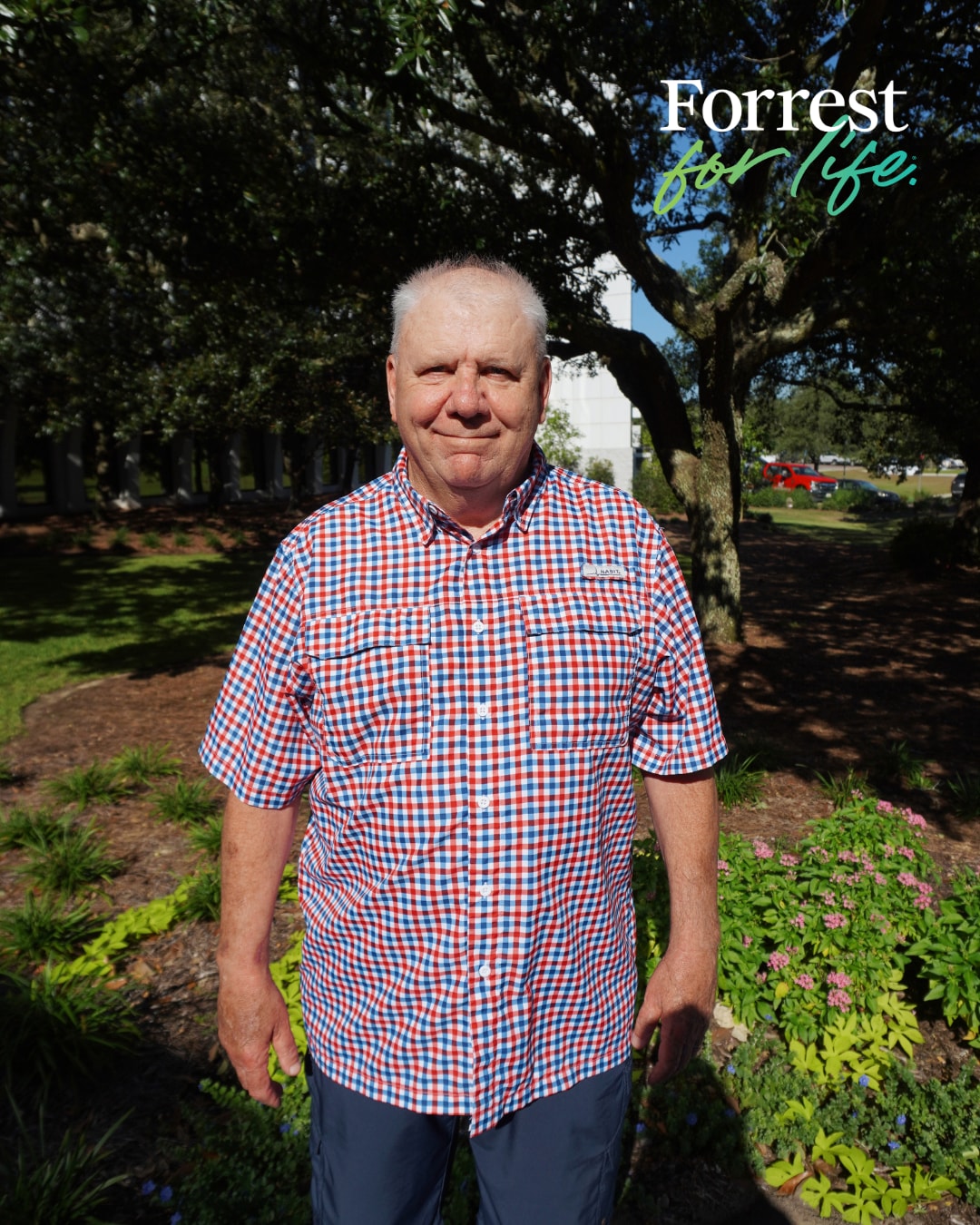
Thanksgiving morning was unfolding just as it should at Reid Wall's home in the Dixie community.
The 69-year-old was helping his wife, Mary, prepare dinner, stirring a pot of his mother's chicken and dumplings — with real dumplings. Family was nearby, and Reid was looking forward to a holiday spent with the people he loved.
Then, in an instant, everything changed.
Reid turned to stir the pot and stumbled. Mary grabbed him in a bear hug and called for their daughter, Christian, a nurse practitioner in Forrest General Hospital's Emergency Department who was in the next room.
Christian immediately recognized the signs of a stroke. Her dad's face was drooping on the left side, his speech was difficult to understand, and he was losing strength on that side of his body.
"In that moment, it's like you can't believe this is happening," Christian said.
An ambulance was called, and Christian contacted Forrest General's Emergency Department, speaking with nurse Amy Nicholson about her dad's symptoms and when they began.
At Forrest General, the stroke team was ready when Reid arrived. A CT scan ruled out bleeding in the brain, and he was given clot-busting medication to help restore blood flow.
Just 11 minutes had passed between his arrival and the administration of the medication.
Within minutes, Reid's symptoms began to disappear. His speech cleared, and the weakness faded.
Further testing revealed a large vessel occlusion (LVO), a blockage in one of the brain's major arteries that can cause a devastating stroke.
Christian knows how differently things could have turned out.
"I think a lot of patients or families decide to wait, some even until the next day, and see how the patient gets before taking them to the hospital," she said.
But with a stroke, every minute matters. Recognizing the warning signs, calling 911 immediately, and knowing when symptoms began or when the person was last known to be well can make all the difference. For eligible patients, clot-busting medication generally must be administered within four-and-a-half hours of when they were last known to be well.
For Reid, the stroke also uncovered another serious health concern.
Doctors discovered he had atrial fibrillation (AFib), an irregular heart rhythm that increases the risk of blood clots and stroke. Reid had no idea he had the condition, although he recalled feeling unusually tired since September. He had simply attributed it to getting older.
Additional hospital stays and treatment by cardiac electrophysiologist Mark Borganelli, MD, and Forrest General's cardiac team helped restore his normal heart rhythm. Because his heart had weakened, Reid also wore a LifeVest, a wearable defibrillator, for about three months.
Through it all, Reid was grateful for the care he received.
"It was just wonderful," he said.
Today, he pays closer attention to what his body is telling him.
"You know your body the best, so if you feel like something's off, go ahead and get it checked out," Christian said. "Don't take a nap and try to sleep it off. Don't attribute it to old age."
Reid is especially thankful his daughter was there that Thanksgiving morning. He admits that without her, he might have been a little more stubborn about going to the Emergency Department.
"But I can't put my foot down with Christian," he said.
Today, Reid has no lasting neurological deficits from his stroke.
He's back to taking his 10-year-old grandson Easton to school, picking him up in the afternoons, and the two of them spending time together. They watch television, keep each other company, and look out for each other.
Sometimes, Reid admits, Easton does a little more of the looking out.
"He's a normal 10-year-old, and sometimes he starts getting out of hand," Reid said. "All it takes is for his mom to say, 'Now don't upset Pappy. You know he's a stroke victim. We've got to be careful.'"
The family recently returned from a trip to the Smoky Mountains, where Reid joined them for hiking and an 11-mile e-bike ride. The ride required more pedaling than he expected, but he kept up.
At one point, Easton had gotten ahead of the group and disappeared from sight. When another visitor called out that there was a bear nearby, Reid had other things on his mind.
"I told him I can't look. I've got to find my grandson," Reid recalled.
For Reid, keeping up with Easton is part of what keeps him moving.
"He keeps me going," Reid said.
And perhaps that's one of the greatest gifts Reid has received since that frightening Thanksgiving morning — the chance to keep doing the ordinary things that make life special. School pickups. Family vacations. Tailgating in the Grove with his Ole Miss Rebels. Time with his grandson. And another holiday around the table with the people he loves.
Last Thanksgiving, the Wall family's holiday dinner ended up being a handful of Cheez-Its, carefully set out by a little boy who had spent part of his day praying for his Pappy.
This Thanksgiving, Reid hopes there will be chicken and dumplings on the table again.
But for the Wall family, what matters most isn't what's on the table. It's who's sitting around it.