Advanced Treatment, Closer to Home: Forrest® Expands Interventional Radiology Services
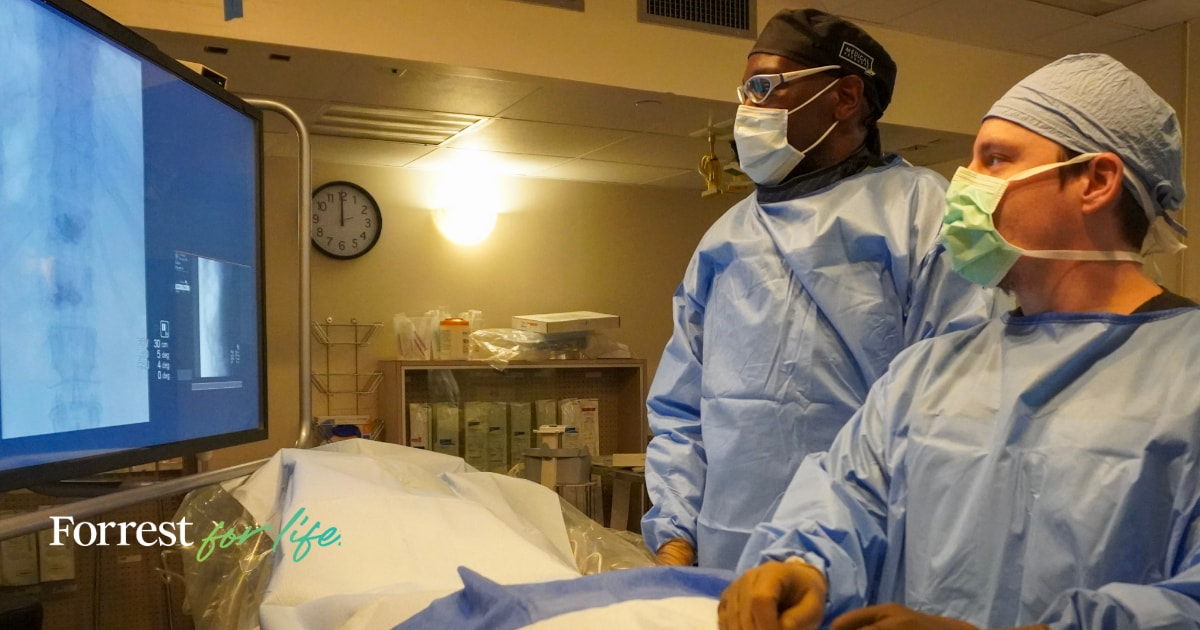
For many South Mississippi patients, treating an enlarged prostate, uterine fibroids, or certain cancers has meant surgery, a hospital stay, or traveling hours from home for specialized care.
Expanded Interventional Radiology services at Forrest® are giving some patients another option.
Using advanced imaging, interventional radiologists can treat a growing number of conditions through tiny incisions rather than traditional open surgery — often allowing patients to return home the same day with less pain and a shorter recovery.
The expanding program at Forrest® includes treatments for enlarged prostate, uterine fibroids, chronic subdural hematomas, and certain cancers, with additional procedures being added.
The growing program now includes interventional radiologists Marshall Hutchison, DO, and Anay Thodge, MD, expanding access to these specialized treatments for patients throughout South Mississippi.
“I am excited to join the Interventional Radiology team at Forrest® and look forward to expanding the services we can offer patients in our community,” Thodge said. “Current advances in medical imaging and technology allow us to provide innovative and safe treatments, while keeping the patient at the center of everything we do.”
For Hutchison, expanding those services is about more than adding procedures. It’s about bringing advanced care closer to the people who need it.
During his Interventional Radiology training in Louisiana, Hutchison saw patients travel hours for procedures that weren’t available closer to home. He remembers patients asking why that same care couldn’t be offered nearer their communities.
Now, back in his home state, Hutchison is helping bring some of those treatment options to South Mississippi.
For men with benign prostatic hyperplasia, or BPH, an enlarged prostate can press on the urethra and cause urinary problems that affect everyday life. Prostatic Artery Embolization (PAE) uses a catheter to reach the arteries supplying the prostate and tiny particles to reduce its blood flow. Over time, the prostate shrinks, which can improve symptoms.
PAE can provide another option for some men who want to avoid a more invasive procedure or who have previously undergone treatment and experienced recurrent symptoms.
Women with uterine fibroids also have a minimally invasive alternative to traditional surgery. Uterine Fibroid Embolization (UFE) treats these noncancerous tumors by blocking the vessels supplying them with blood, causing the fibroids to shrink.
For some women, UFE can reduce symptoms such as heavy menstrual bleeding, pelvic pressure, and pain while allowing them to avoid a hysterectomy.
Interventional Radiology is also providing another treatment option for some patients with chronic subdural hematomas, a condition in which blood collects between the brain and its outer covering. The condition can occur following head trauma and is more common among older adults and people taking blood-thinning medications.
Middle Meningeal Artery (MMA) embolization is a minimally invasive procedure that reduces the blood supply contributing to the hematoma and may lower the risk of it recurring.
“This treatment may allow some patients who require anticoagulants to resume them sooner, reducing the competing risk of problems such as pulmonary embolism or deep vein thrombosis,” Hutchison said.
Interventional Radiology is also expanding treatment options for some patients with cancer.
One of those treatments is Y-90 radioembolization, which is generally used for certain primary or metastatic liver tumors. Instead of delivering radiation externally through the body, Y-90 allows physicians to deliver radiation directly to the tumor through its blood supply.
Before treatment, patients undergo a mapping procedure that allows the Interventional Radiology team to evaluate the blood vessels supplying the tumor and plan the treatment. Patients then return for the outpatient procedure, during which an interventional radiologist guides a catheter through the blood vessels and delivers microscopic radioactive beads directly to the tumor.
“For the majority of these procedures, a patient doesn’t have to be hospitalized,” Hutchison said. “The only procedure we usually keep patients overnight for is the fibroid treatment, and we do that just for pain management.”
Other minimally invasive cancer treatments available through Interventional Radiology include cryoablation and microwave ablation, which use extreme cold or heat to destroy tumor tissue.
For certain patients with small lung tumors who aren’t good surgical candidates because of limited pulmonary function or other medical conditions, these procedures may provide another treatment option without traditional surgery.
Interventional Radiology can also play a role in managing cancer-related pain. A celiac plexus block or neurolysis targets a group of nerves that transmit pain signals from the upper abdomen and may provide relief for some patients with pancreatic cancer and other upper-abdominal conditions.
Together, these procedures represent a growing area of medicine known as Interventional Oncology, which uses image-guided, minimally invasive techniques to diagnose and treat cancer and manage some cancer-related symptoms.
“We want our community to know that these advanced treatments are now available close to home as we continue to expand Forrest’s Interventional Radiology program and the services we provide,” said Shannon Vega, director of Radiology at Forrest®. “This means that patients can potentially receive more minimally invasive treatment options without having to leave their community.”
Patients who think they may benefit from Interventional Radiology services should talk with their physician about a referral to a Forrest® interventional radiologist.